QR Code on a Windshield: Is It Legal?
With QR code stickers appearing on more and more car windshields — for anonymous messages, parking notifications, or contact services — drivers everywhere are asking: am I actually allowed to stick one on the glass? The short answer is yes, with conditions. Here is exactly what the law says.
What French law actually says
The key text is Article R316-3 of the Highway Code, which requires windshields and front side windows to provide "sufficient transparency" and not impair driver visibility. It specifically prohibits "any non-transparent object" that would restrict the driver's field of vision.
In practice:
- The wiper blade sweep area must stay clear on the driver's side.
- Nothing may obstruct direct sight lines to the road, signs, traffic lights, or pedestrians.
- The rear-view mirror and ADAS camera (if fitted) must not be covered.
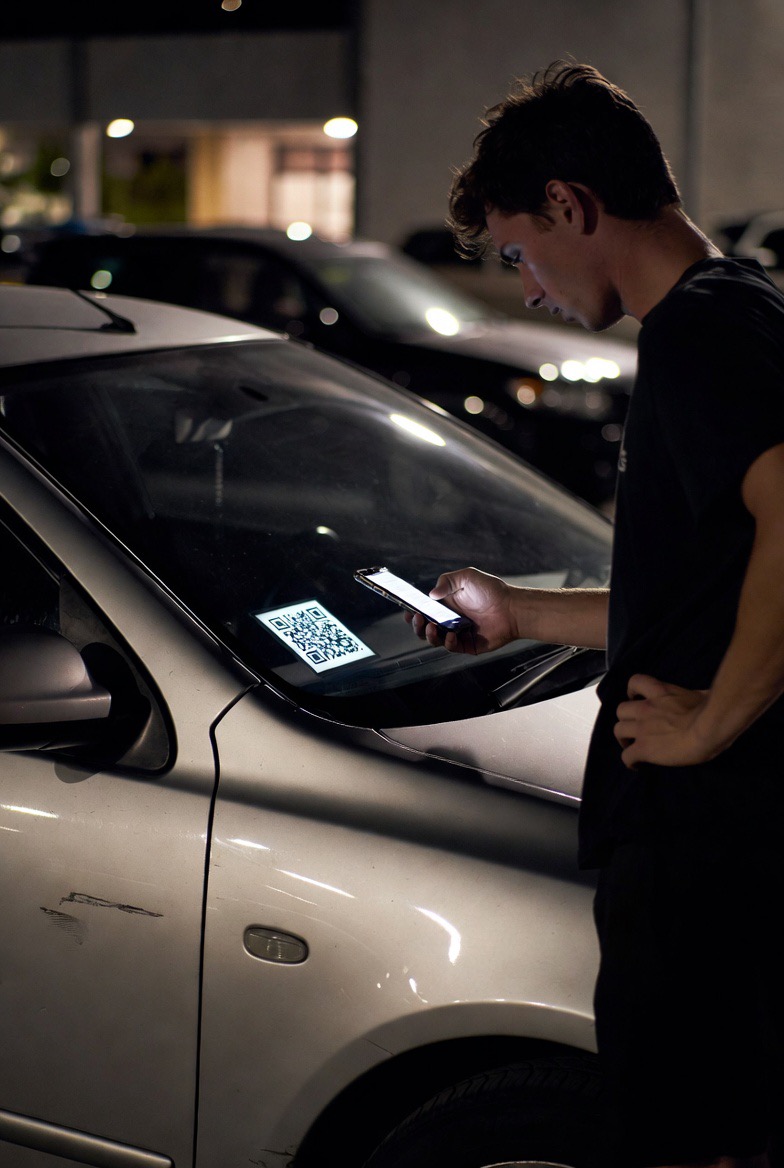
A small QR code sticker in a corner of the windshield comfortably meets these requirements — the same legal logic as the Crit'Air emission sticker, the insurance disc, or the toll badge.
Where to place it (and where not to)
To stay compliant:
- Avoid: the driver-side wiper sweep zone, directly behind the rear-view mirror, the centre of the windshield.
- Recommended: lower right corner (passenger side), alongside other official stickers.
- Size: 5 to 8 cm square maximum — discreet enough yet easily scannable from outside.
For the rear window, rules are more relaxed, but usefulness is lower since passers-by need easy scanning access.
Note: if your car has an ADAS camera behind the windshield (adaptive cruise, automatic emergency braking), check the owner's manual to make sure your sticker doesn't cover the camera's analysis zone.
What about the roadworthiness test?
The French contrôle technique checks driver visibility under check point 3.1 ("glazing"). Defects noted include: cracks in the field of vision, an overly opaque tint film, or objects significantly reducing visibility.
A small corner QR code is not a problem — same standard as the insurance disc or Crit'Air sticker. If you want extra peace of mind, peel it off 5 minutes before the test and reapply it after — quality stickers support repositioning.
No official ruling or technical inspection report has ever cited a small, well-placed QR code as grounds for a failed test.
GDPR and your personal data
Putting a QR code on your car naturally raises a question: what data is in circulation? Reputable services like Klaxie are built to comply with GDPR:
- The QR code contains no phone number, name, or address.
- It links to an anonymous URL hosted on a European server.
- The driver receives messages via an app, with no personal data exposed to the scanner.
- The person scanning does not need to create an account.
Be cautious about DIY "print your own" stickers that encode your actual phone number: technically legal, but you're exposing yourself to spam, scam calls, and unwanted solicitation.
Special cases: company cars, rentals, leasing
- Company car: check with your employer. Some fleet policies prohibit any exterior personalisation.
- Short-term rental: avoid it — rental companies charge for adhesive residue removal. Use removable suction-cup mounts instead.
- Leasing / PCP: no issue during the contract, as long as the car is returned clean. Quality stickers peel off without trace using a hairdryer and a little isopropyl alcohol.
Bottom line
Yes — a QR code on your windshield is perfectly legal in 2026, provided you follow three principles: reasonable size, placement outside the driver's sightline, and a service that genuinely respects your privacy. It is a solid alternative to writing your phone number on the glass, which is legal but exposes you to real spam and harassment risks.
Want to try an anonymous windshield QR code? Join the Klaxie waitlist to be notified at launch.
Read next: How to print and stick your QR code · QR code vs anti-theft alarm